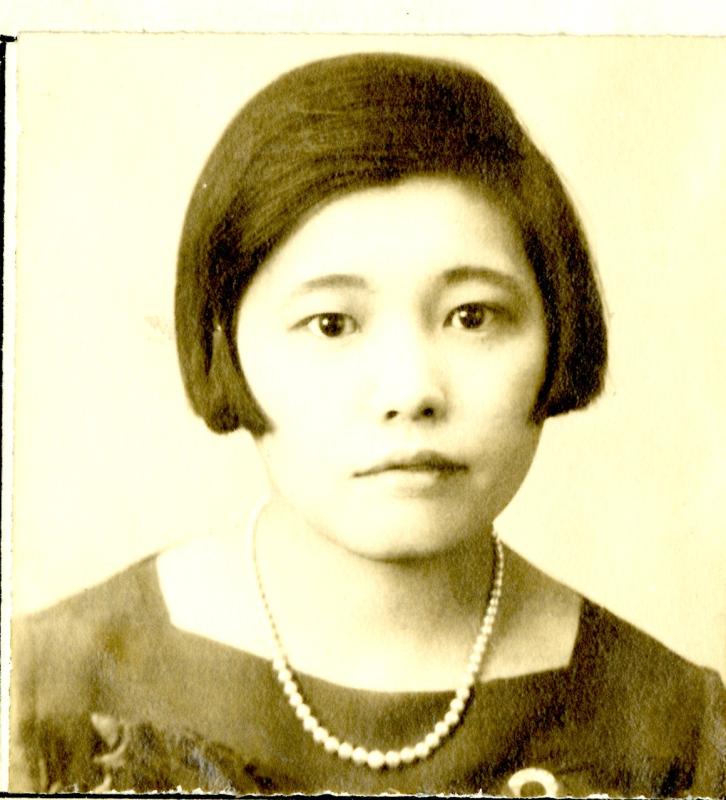
We are pleased to run this guest blog post written by Jingwen Zhang, a member of the Vagelos College of Physicians and Surgeons, Class of 2023 -- SN
Asian Pacific American Heritage Month is coming to a close, and reflecting on the history of Asian Americans in the medical field affiliated with Columbia, we cannot overlook the very interesting and inspiring story of Dr. Megumi Shinoda (1908-2007), the first Asian-American woman graduate of the Vagelos College of Physicians and Surgeons, Class of 1933. She was one of the two first Asian-American women to receive an M.D. in the country, as well. Since she was a Japanese American living through World War II and an early woman in medicine, she—unsurprisingly—faced and overcame challenges that most of her peers never had to consider during her ultimately lengthy and varied medical career.
Dr. Shinoda (née Yamaguchi) was born in Cleveland while her father, Dr. Minosuke Yamaguchi, was finishing medical school at Western Reserve University, now Case Western Reserve. She was one of seven siblings, four of whom eventually became physicians. Her family later relocated to New York City, creating what a local journalist called a “Japanese colony” in Inwood, similar to other ethnic enclaves that formed throughout the city’s history. Her father was considered the leader of this “colony,” which was well-regarded and praised by their neighbors for their apparent assimilation and patriotism, including building a church to serve their predominantly Christian population and taking up “war gardening” to help with the World War I effort.
Megumi Yamaguchi attended Barnard College and graduated with Phi Beta Kappa honors prior to applying to P&S in 1929. She was initially notified that she “complied with the requirements for admission to our first year class,” but “the quota for women has been chosen,” landing her on the waitlist instead. A month later, she was admitted from the waitlist and began her medical education that fall. We know little about her experiences in medical school, other than that she completed her sub-internship at the Jersey City Hospital and received Alpha Omega Alpha honors. At the time of her graduation, she noted in a letter to a professor, “I wish I could tell you just how much P&S has come to mean to me. I have enjoyed my four years there tremendously.”
She applied for a residency at the Los Angeles County General Hospital and was the first Japanese American intern there. She married her husband Joseph Shinoda shortly after, and they had their first child in 1936. Upon finishing her training, Dr. Shinoda ran an OB/GYN-focused general practice in Los Angeles’ Little Tokyo and “probably delivered half of the Japanese-American babies in Los Angeles,” as noted in her obituary in the Los Angeles Times.
Her medical career was interrupted by World War II and the resulting anti-Japanese sentiment, which culminated in the unprecedented and widespread internment of Americans of Japanese descent, including those born in the U.S., or whose families had been in the U.S. for generations. After Pearl Harbor, President Franklin D. Roosevelt issued Executive Order 9066, which authorized the “relocation” of anyone deemed a security threat. Military officials targeted all people of Japanese ancestry on the West Coast, first imposing curfews, then encouraging the voluntary relocation of Japanese Americans inland (which very few did), and finally forcibly relocating and effectively incarcerating all people of Japanese ancestry in camps located in remote, desolate, and landlocked areas of the American West, ostensibly to prevent them from aiding the armed forces of a country that most of them never knew. With next to no notice of this forced relocation, most people could not make arrangements and permanently lost their homes, property, and businesses when they were relocated. Over 40 years later, the U.S. government formally apologized and admitted that their actions were based on “race prejudice” and “war hysteria” rather than military necessity.
Dr. Shinoda’s practice, like other Japanese American businesses on the West Coast, was shut down. She returned to New York and did not have to go to the camps, though several of her relatives were less fortunate. Her father, as an East Coast-based “sponsor,” was able to help some family members leave the camps and attend school elsewhere in the country. In 1943, Dr. Shinoda asked her professors at P&S for assistance and recommendations in securing positions in Colorado and Utah. “[I] would undoubtedly be still in general practice were it not for the war and the unfortunate fact of my Japanese ancestry,” she wrote, “which along with all other people of my race uprooted me from a pleasant existence on the west coast.” She also wrote about possibly pivoting to psychiatry, as she was a mother of two at this time, and wanted to spend more time with her children than she would if she continued primarily practicing OB/GYN.
After the war, Dr. Shinoda was able to move back to Los Angeles and resumed* her general medical practice in 1946, which soon thrived once more. According to her niece, she also ran a popular health advice column in a newspaper for the Japanese American community. For her contributions to the community, her niece said, she was given a spot on the “walk of fame” on First Street in Little Tokyo, where her medical bag was inscribed in the cement.
Eventually, Dr. Shinoda revisited the idea of practicing psychiatry and started a successful psychiatric practice in Hollywood, which she ran until her retirement at age 88. She passed away at age 99, survived by her daughter Dr. Jean Shinoda Bolen, who also became a successful psychiatrist as well as a writer, and leaving behind a significant legacy in the Japanese-American community of Los Angeles.
One could perhaps say that Dr. Shinoda was already predisposed toward the medical field, given that her father was a doctor himself, but she could not have foreseen the barriers in her way, especially as an Asian woman of Japanese descent, which required resilience and flexibility to navigate her ultimately meaningful and far-reaching journey. Her greatest impact may have been in Los Angeles, but her home base was undoubtedly in New York, where she paved the way for more students like her to join the ranks of Columbia’s medical graduates, persevering against the backdrop of stereotypes, “bamboo ceilings,” and the tumultuous tide of public opinion that turns against Asian Americans time and time again, even today.
Besides the material found at the links, information for this post also comes from Dr. Shinoda’s student record held by Archives & Special Collections, A.C. Long Health Sciences Library.
Photograph of Megumi Yamaguchi Shinoda from her medical school admissions application, 1929.
*Page 6.