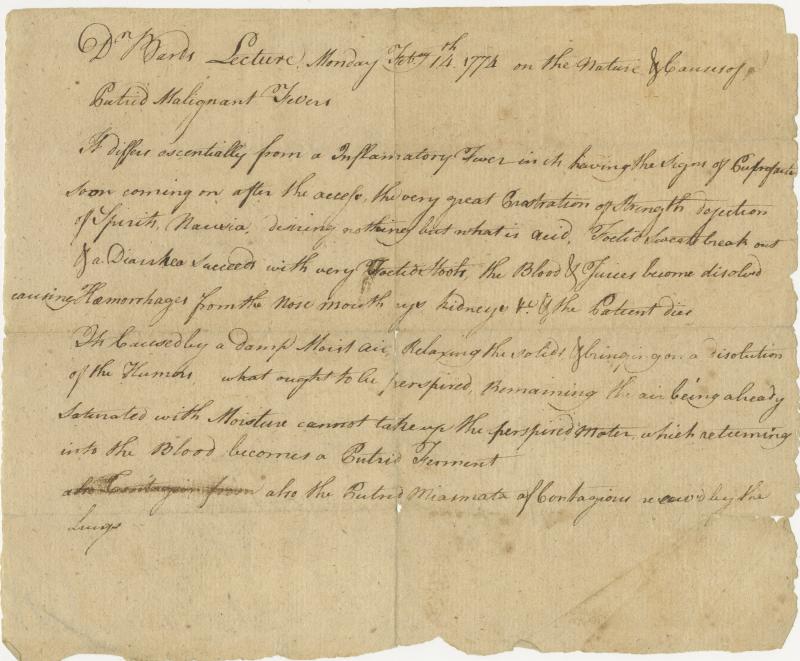
Students keep notebooks for plainly utilitarian reasons: as an aid to learning and as a mnemonic device. For historians of medicine, student notebooks are an invaluable resource for the study of medical education and for the history of medicine in general. For the biographer, they may give insight into the mind of a particular individual. And, occasionally, notebooks can even be small works of art.
On display now in Lower Level 2 of the Hammer Health Sciences Building is an exhibit of some of the over 150 student notebooks held by Archives and Special Collections at the A.C. Long Health Sciences Library. Highlights include James Graham’s 1774 notes of a class taught by Samuel Bard, one of the founders of the College of Physicians & Surgeons; the notebook of Charles Drake (P&S 1812) opened to an elaborately decorated title page; a tattered 1827 volume with notes of lectures given by the celebrated Dr. David Hosack at the rival Rutgers Medical School; and doodles in a notebook by George Huntington (P&S 1871), for whom Huntington’s Disease is named.
One of the most striking items is a gorgeously illustrated volume recording cases seen at the College’s “Friday Afternoon Clinic” in gynecology in 1872-73. The student notebook of the long-time P & S professor of physiology, John G. Curtis (1844-1913) contains meticulous anatomical sketches. Other items on display include notebooks with early references to the germ theory of disease and Freudian psychoanalysis.
The exhibit can be seen on Lower Level 2 of the Hammer Health Sciences Building, 7am-9pm, through Dec. 18. It is open to anyone holding a valid Columbia University or New York-Presbyterian Hospital ID card.
Image: "Dr. Bards Lecture Monday Febry 14th, 1774 on the Nature and Causes of Putrid Malignant Fevers," from Graham Family Papers.